Dogs, as a species, seem to understand portraits.
You point a camera at a dog and they do something. They tilt their head. They assume an expression of grave importance. They make themselves available for documentation in a way that borders on cooperative.
Cats are different.
Cats live in a state of profound indifference to whether you capture them well. They will move the instant you get the focus right. They will close their eyes at the exact moment the light is perfect. They will express exactly one emotion — mildly suspicious tolerance — and offer it to the camera in the worst possible light.
And yet: cat portraits, when they work, are extraordinary.
What Makes a Cat Portrait Difficult
The difficulty isn't just the cat's lack of cooperation. It's the nature of what makes cats visually interesting.
A cat's face is built around the eyes. The eyes are large relative to the face, set wide, and capable of expressing an enormous range of internal states — from the narrow suspicious squint to the full slow-blink of trust, from the dilated excitement of a hunting cat to the half-closed contentment of one who has decided your lap is now their property.
Getting those eyes right is everything.
The coat adds another layer of complexity. Short-haired cats have fur that reads as texture — the direction matters, the sheen matters, the way it catches light along the spine and dulls in the shadows. Long-haired cats (Ragdolls, Maine Coons, Persians) have fur so complex that a simplified portrait often looks more like a cloud than a cat.
And then there's expression. Cats have seventeen facial muscles. Humans have forty-three. The difference seems like it should make cats simpler to capture — but the subtlety of what those seventeen muscles can communicate is extraordinary.
 A watercolour cat portrait where the expression is the whole point — alert, present, a little suspicious
The Reference Photo Problem (And How to Solve It)
Most people's cat photos are disasters.
Not because they're bad photographers — but because cats move constantly, often refuse direct eye contact with the camera, tend to seek out the darkest corner of any room, and have a supernatural ability to look slightly wrong in photographs even when they look magnificent in person.
Here's how to get a usable reference photo:
The slow approach. Don't pick up the phone the moment a good light hits them. Cats notice sudden movement and immediately change position. Watch for a good moment, then slowly, without sudden movement, get the phone out and ready before you point it.
Wait for stillness. The best cat photos come when a cat is fully at rest — not just sitting, but in the deeper stillness of a cat who has decided not to move for a while. Watch the breathing. When it slows and becomes regular, that's the moment.
Get eye level. This is the most important technical point. Looking down at a cat from above compresses the face and makes the eyes look smaller. Lying on the floor, getting the camera at their exact eye level, transforms the same cat into something photogenic.
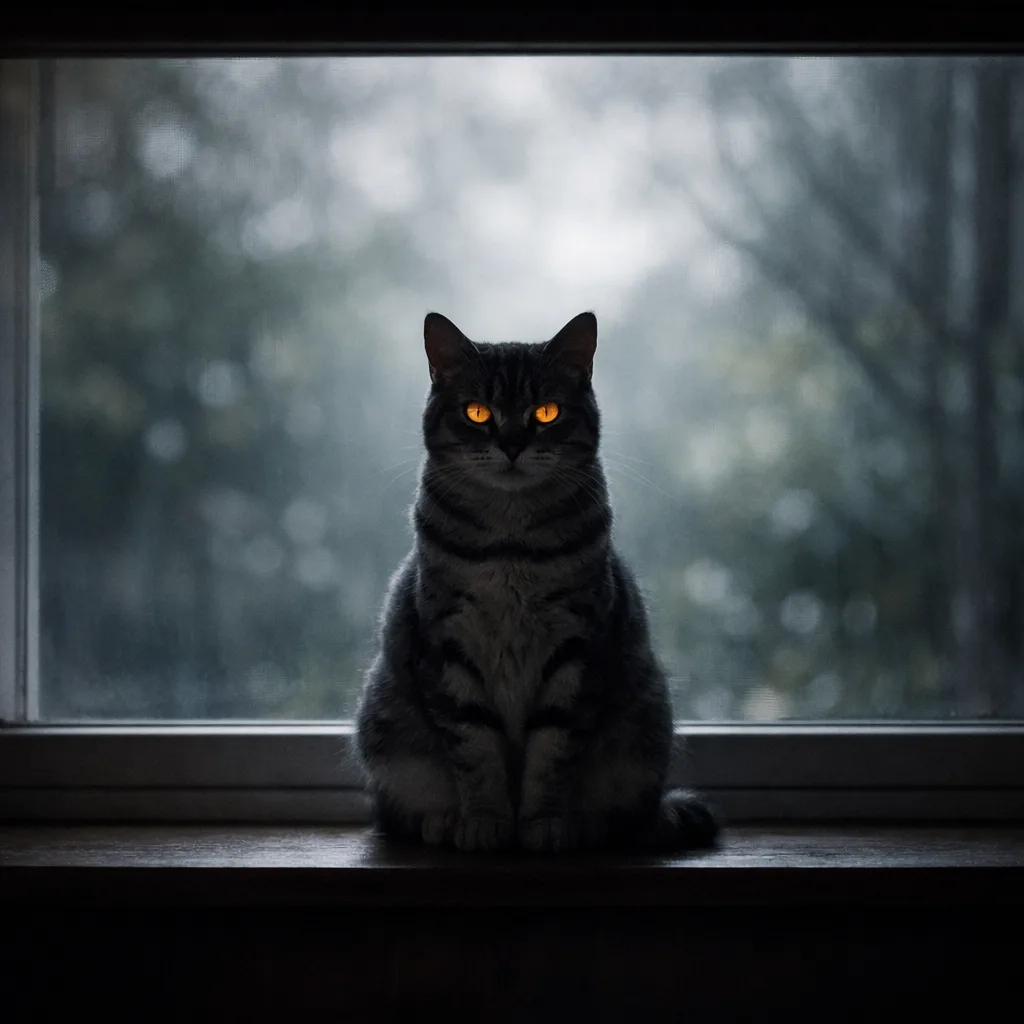
Window light, but not direct sun. A cat sitting in a window is a classic composition for a reason — the light is directional without being harsh. Direct sunlight bleaches colour and creates blown-out patches. Diffuse window light on the side of the face is the goal.
The slow blink trick. If you want a cat to look at the camera with relaxed, open eyes rather than suspicious narrow ones: slow-blink at them before you take the photo. This is the feline equivalent of saying "I'm not a threat." Many cats respond by relaxing their eyes and even slow-blinking back. That's the shot.
Styles That Work for Cats
Not all portrait styles suit all animals equally. For cats specifically:
Classic watercolour works beautifully for most cats — the loose brushwork and colour washes suit the soft texture of fur, and the warm background tones suit the typical warm colouring of tabby cats, ginger cats, and many bicolours.
 The Heaven style — soft golden clouds, peaceful light — works particularly well for cats with light colouring
Heaven style (soft clouds, golden diffused light) is perhaps the most popular for cat portraits, and you can see why: it creates a portrait that feels timeless and peaceful, which suits the particular quality of a cat's stillness.
King or Queen style (regal crown, formal portrait styling) is where cat portraits become genuinely funny in the best way. Cats already carry themselves with the bearing of someone who expects to be waited on. Putting a crown on one simply acknowledges what they clearly already believe about themselves.
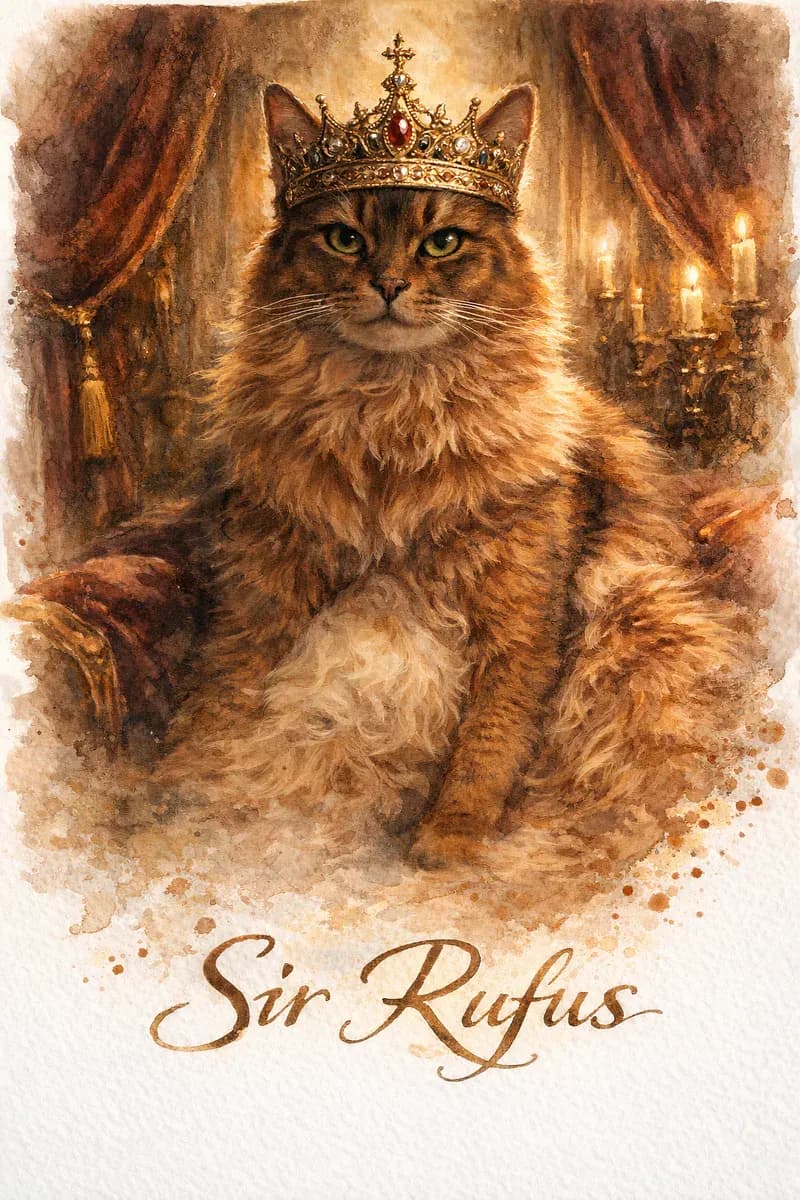 The King style: a crown, formal framing, and an expression that says this was expected
Night Glow / Cosmic styles work particularly well for dark-coloured cats — black cats, dark tortoiseshells, charcoal tabbies — who can disappear in lighter-background styles but come alive against a deep cosmic backdrop.
The Difference Between a Good Cat Portrait and a Great One
A good cat portrait is accurate. The markings are right. The proportions are correct. You can tell it's that specific cat.
A great cat portrait captures something harder to describe — the quality of presence the cat has. The exact way they hold themselves. The specific expression that made you fall for them in the first place.
This is harder to achieve, and it comes from the reference photo as much as from the portrait style. The photo where your cat looks most like themselves — not their most technically beautiful photo, but the most them — is almost always the better reference.
You'll know it when you see it. It's the photo you find yourself returning to.
Cats as Gifts for Cat People
A cat portrait makes a different kind of gift than a dog portrait, because cat people are different.
Not in terms of loving their animal — they love them just as fiercely. But the relationship often has a different quality. Dog ownership tends to be public and social; dogs go places with you, they meet your friends, they're part of your visible life. A cat is often a more private relationship — the comfort they provide, the way they choose who they trust, the strange intimacy of being genuinely liked by a creature that likes no one.
A portrait of someone's cat acknowledges that private thing. It says: I know this is important to you, even though it's not always visible.
That's worth a lot.
Practical: How to Order a Cat Portrait
The process is the same as for any portrait, with a few cat-specific notes:
- Choose your best reference photo using the guidance above — eye level, window light, eyes open and in focus.
- Choose a style that suits the cat's colouring and personality (Heaven or classic watercolour for most; King/Queen for the imperious ones; Cosmic for dark-coated cats).
- Preview before purchasing. At petportraitgift, you see the portrait before you pay. For cat portraits specifically, this matters — you want to verify the eyes look right before committing.
- Decide on format. Digital download (instant, print anywhere) or gallery canvas (arrives ready to hang).
One more thing: if the first portrait doesn't capture the eyes quite right, use the revision option. The eyes are the portrait. Everything else is secondary.
👉 Create a cat portrait — free preview →
A Final Note on the Uncooperative Subject
Your cat will never sit still long enough for you to feel certain you have the photo. You will always wonder if there was a better one.
This is fine. Use the best photo you have. The portrait will tell you more about your cat than the photo does — because a good portrait isn't a copy of a photograph. It's an interpretation of what you already know.
The painter (or the algorithm, as the case may be) sees what the photo almost captured, and finishes the thought.
PetPortraitGift creates custom cat portraits from your photos — watercolour, Heaven, King, Cosmic and more. Free preview before purchase. See your cat as art →